






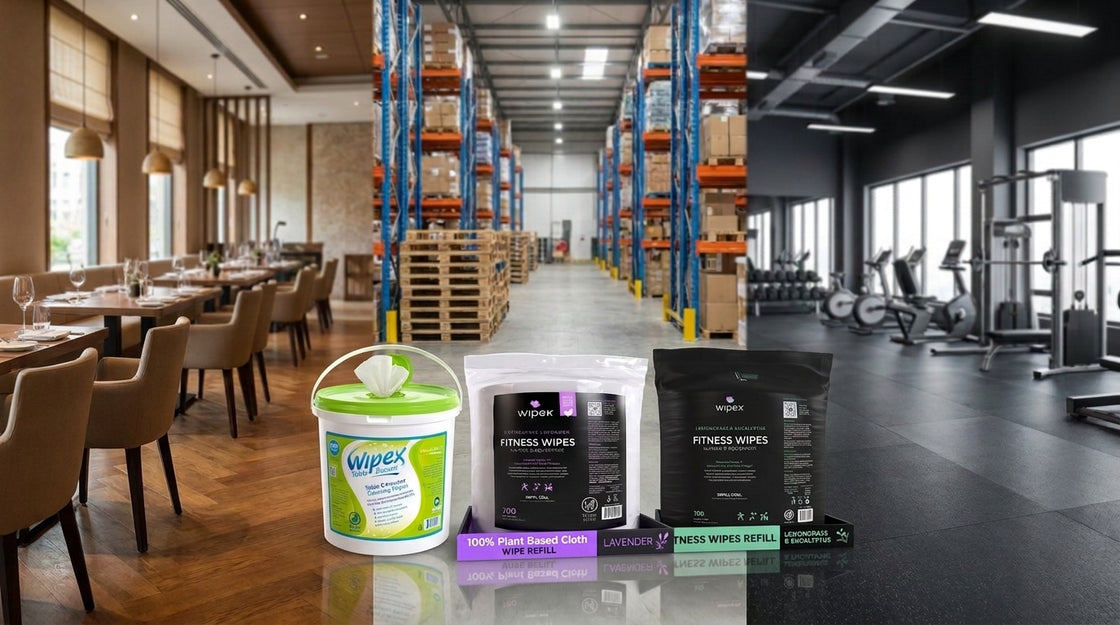
This guide turns that drift into a program: one approved list, one dispenser standard, one reorder that triggers itself, and a cost-per-use number you can defend in a Q4 budget review. It is written for the buyer who signs off across sites — procurement managers, operations directors, and franchise or multi-unit owners.
Quick answer / key takeaways
- A multi-location program is four decisions: par level per site, one approved SKU list for the footprint, one dispenser standard, one delivery cadence.
- Standardise first. One organisation cut its facility SKUs from 300 to 60 core items and made ordering and storage simpler the same quarter.
- Consolidation does not change what a wipe costs — it removes the spend you did not plan: the local reorder, the duplicate SKU, the emergency order.
- Reactive buying is the hidden tax: an emergency order that covers a stockout costs 20–30% more than planned replenishment.
- Set reorder points from a formula, not a hunch: Par Level = (Daily Usage Rate × Lead Time) + Safety Stock.
- Our bulk refill roll works out at about $0.06 per wipe, and the pallet pack about $0.05 — roughly half a bucket's unit cost.
On this page
What is multi-location cleaning supply procurement?
Multi-location cleaning supply procurement is the practice of buying and replenishing consumables — wipes, liners, chemicals, paper — under one standard across several facilities. Without it, each site buys on its own. It has two halves. The supply half decides what the footprint buys and in which pack size. The operating half keeps every site running that standard after the launch: par levels, reorder triggers, dispenser fit, and a usage number per location.
Most operators stop at the supply half. They standardise once, then lose it within two quarters because nothing governs the sites day to day. The two halves also fail differently. A weak supply half shows up as spend you cannot explain. A weak operating half shows up as ten sites that each believe they are following the standard and none of them are.
Why this matters in Q4
Q4 is when the next year's supply reality gets decided. Budgets close, contracts renew, and the same conversations repeat in a compressed window. It is also the quarter where cleaning-supply cost becomes a visible line. Search interest around the cost of cleaning supplies climbs into late November, and office-cleaning activity hits its second seasonal peak in mid-November as workspaces reset for winter occupancy.
That gives a multi-location buyer a natural deadline. If you want the program running by January, the standardisation audit has to happen while the budget is still open — not in February, when the money is committed and the sites have reordered on habit. The benchmark figures behind that: centralised procurement spend runs $4.92 per $1,000 of revenue against $6.10 decentralised, and an emergency order covering a stockout carries a 20–30% premium over planned replenishment (Metro Wholesale, checked 2026-09-28).

What the program saves: cost per wipe
Cost per wipe is one price divided by one count. Cost per use is that number meeting real consumption. Both belong in the same review, because a cheap wipe that a site uses twice per task is not cheap. Every figure below is the list price on the product page, divided by the pack count.
| Product | Variant | Price | Count | Cost per wipe |
|---|---|---|---|---|
| Natural Fitness Equipment Wipes 700ct Bulk Refill Roll | Single roll | $42.99 | 700 | ~$0.061 |
| Natural Fitness Equipment Wipes 700ct Bulk Refill Roll | 4-pack | $142.99 | 2,800 | ~$0.051 |
| Plant-Based 700ct Bulk Refill Roll (viscose) | Full pallet (140 rolls) | $4,585.00 | 98,000 | ~$0.047 |
| Table Bussers® Surface Wipes | 1 bucket | $36.99 | 400 | ~$0.092 |
| Table Bussers® Surface Wipes | 4-pack case | $119.99 | 1,600 | ~$0.075 |
A fuller breakdown of the refill format and its dispensing options sits in Gym Wipe Dispensers vs. Buckets.
Take one site that burns 500 wipes a week. On a bucket that is roughly $46 a week before any emergency premium; on the refill roll it is closer to $26. Multiply the gap by every site in the footprint and by the weeks in a year, and the program's whole justification sits in that line. No cleaning claim is required, because the arithmetic is about price and consumption, not about how well anything works. Stack the reactive premium on top and the gap widens further — an emergency order looks like a normal invoice until you compare it against what a planned one would have cost.
The formula to hand to each site:
daily wipes used × days of lead time = reorder trigger
footprint demand = sum of every site's par level
footprint cost per cycle = footprint demand × cost per wipe at the pack size the footprint buys
Calculate your footprint cost
Cost figures only, from the prices you enter. Check your own invoice.
Cost-per-use calculator
Enter your own footprint and the numbers update.
Reorder the formula for your own operation and the argument holds or it does not — that is the point of showing the arithmetic instead of a slogan.

Frequently asked questions
What is a multi-location cleaning supply procurement program?
One standard for buying and replenishing consumables across several facilities: one approved SKU list for the footprint, a par level and reorder trigger per site, one dispenser standard, one delivery cadence. The supply half sets what you buy; the operating half keeps every site on that standard after launch.
Does buying across sites change our price?
No. The price is the price on the product page, and the pack size you order is what sets the cost per wipe. What consolidation removes is the spend you did not plan: the local retail reorder, the duplicate SKU, and the emergency order that covers a stockout at a 20–30% premium. Discounts are separate from all of it — a subscription, or a discount already running on the product page.
How do we consolidate SKUs without breaking how the sites work?
Audit first, then collapse. List every product actually present at each site, identify the duplicates that do the same job, and settle on one approved item per category. Formats can differ by room type, but if the format differs by site for the same room, consolidation fails — the reorder cannot run on two standards at once.
How do we set reorder points?
Use the par-level formula: (Daily Usage Rate × Lead Time) + Safety Stock. Measure the daily usage rate on a normal week, add a buffer sized to your worst realistic delay, and label the shelf with the resulting number so anyone can trigger the order.
Should every location run the same dispenser?
Yes, per room type. Dispenser standardisation is what lets one refill fit every site, which is what lets a single order cover the network. Mixed hardware forces special orders, and special orders are the front door to the emergency premium.
Which pack size should the footprint standardise on?
The one your rooms actually run. A refill roll pairs with one dispenser standard and lands at about $0.061 per wipe at the single-roll price and $0.051 in the 4-pack; a bucket suits front-of-house reset at about $0.092. The cost per wipe moves with the pack size you choose — that is the only lever here, and it is printed on the product page.
How do we keep the program running after launch?
Set the par levels, put the approved list and the dispenser standard in writing, and let one cadence drive replenishment. Track cost per wipe and stockouts per site, so the standard can be checked rather than assumed.
How do we know whether the program is working?
Track two numbers per site: cost per wipe and stockouts. If cost per wipe is stable and stockouts fall after the par levels go in, the operating half is holding. If emergency orders persist, the par level is set too low or the dispenser standard is not uniform.
Open a step to see how it runs on the ground.
The six-part program framework
Run the six parts in this order. The order matters: reorder planning and the pack-size decision come before dispenser choices, and SKU consolidation comes before delivery, because you cannot ship a standard you have not agreed on.
1. Reorder planning — par levels per site
A par level is the minimum stock quantity that triggers a reorder, and it is a formula rather than a feeling: Par Level = (Daily Usage Rate × Lead Time) + Safety Stock.
Daily usage rate is what a site actually burns through on a normal day. Lead time is how many days a reorder takes to arrive. Safety stock is the buffer for a busy weekend or a delayed shipment. A site that uses two rolls a day, waits three days for delivery, and wants four rolls of buffer runs a par level of ten. When the shelf hits ten, the order goes in.
The single most useful thing a program does is make that number visible. Label the shelf with the product name, the case quantity, and the par level, so any staff member can flag low stock without a manager doing a walkthrough. Ten sites with a labelled par level reorder the same way; ten sites without one reorder ten different ways.
2. One supplier, one list — what consolidation actually buys
Consolidating spend toward one primary supplier, with most of the SKUs on one list, does not change what a wipe costs. The list price is the list price. What it changes is everything around the product: one supplier to order from, one SKU list to order against, and far fewer of the unplanned orders that carry the stockout premium.
It also makes the pack-size decision consistent across the footprint. Ten sites ordering the same refill roll can be replenished from one place; ten sites each buying a different bucket cannot, because the quantities never line up. Standardisation is what makes a single cadence possible — and it is the cadence, not a negotiation, that removes the emergency premium.
3. Dispenser standardisation — the quiet lever
The dispenser is the decision most multi-location teams postpone, and it is the one that makes the reorder run itself. If three sites run three hardware formats, no single order fits them all, and the "standard" list becomes a suggestion.
Choosing one dispenser format per room type across the footprint means one refill fits every site. It also fixes placement: one dispenser format per room defines where the wipe lives, which is what makes it get used at the point of need instead of being fetched. When the hardware is standard, a stockout at one site is covered by the network's par level instead of a local emergency order.
4. SKU consolidation — one list, not a catalogue
Consolidation is an audit, not a purge. Walk every site's supply room and write down what is actually there. You will find duplicates that do the same job, and specialty items bought once and never reused.
Then collapse it: one approved item per category, one approved wipe per room type, and one place to reorder. Consolidate to a single approved list covering paper, liners, wipes, chemicals, and PPE. Fewer SKUs also means the quantity per item is larger and more predictable, which is what makes a fixed cadence work.
The most common finding in the audit is not waste. It is redundancy — two products, each fine, one of which has to go so the reorder can run on one standard.
5. Recurring delivery — the cadence, not the surprise
Once the list and the par levels exist, delivery becomes a schedule instead of a scramble. Set par levels by site, aggregate the sites into one order on a fixed cycle, and let the cycle — not a phone call — drive replenishment. That is the difference between a 20–30% emergency premium and a planned shipment.
A fixed cadence also makes the footprint easier to forecast. When you know a site's par level and the cycle length, you know its monthly consumption before the invoice arrives.
6. Review cost per wipe and cost per use
Both numbers belong in the same review, because a cheap wipe that a site uses twice per task is not cheap. The cost section above shows the arithmetic with our own list prices, so you can redo it with yours before the budget closes.
Where a multi-location program leaks money
Five leaks show up in almost every multi-site audit. None of them is a cleaning problem — every one is a procurement problem, which is why the fix is a standard rather than a product.
The local reorder
A site that orders on its own account pays the premium that the program exists to remove.
The duplicate SKU
Two products doing one job means two par levels, two storage slots and more cash on shelves.
The mismatched dispenser
A refill that does not fit the site's hardware becomes a special order, then an emergency order.
The invisible usage rate
Without a per-site consumption number, par levels get set from memory and drift within a quarter.
The unmeasured cadence
A delivery cycle nobody tracks quietly becomes reactive buying again.
Audit each one before the next budget cycle closes.
Two decisions, one order
Standardise the list and the hardware, and replenishment stops being a local decision at every site.
Which wipe format fits which site
A mixed footprint usually runs three wipe jobs: fitness equipment, food-service front of house, and general office or shared surfaces. Match the format to the job, then hold that match across every site of the same type.
| Site type | Recommended Wipex product | Why it fits | Cost per wipe |
|---|---|---|---|
| Fitness / gym floor | Natural Fitness Equipment Wipes 700ct Bulk Refill Roll | Refill-roll format that pairs with one wall or floor dispenser standard | ~$0.061 |
| Food-service front of house | Table Bussers® Surface Wipes — Autumn-Scented | Pre-mixed surface wipe built for front-of-house reset; the scented line is NSF-certified and suitable for food service environments | ~$0.092 |
| Sustainability-graded sites | Plant-Based 700ct Bulk Refill Roll (viscose) | Plant-based cloth with EWG Verified and the certified cloth-substrate wording | ~$0.047 (pallet) |
| Shared offices & touchpoints | All-purpose and touchscreen-compatible wipes on the same approved list | One listed wipe per room type keeps the standard visible | — |
If in doubt, test on a small, inconspicuous area first.
Keep the scented Table Bussers on food-service sites; it is the line that carries the NSF certification, so it belongs on the front-of-house standard.
Your Q4 multi-location readiness checklist
Print this and run it before the budget closes.
Progress saves in this browser.
Keep Reading
Run one standard across every site
A multi-location program is not necessary a bigger order. It is one approved list, one dispenser standard, one cadence, and a reorder that runs itself — repeated at every site with the same rules. Get those four in place before the budget closes and the next Q4 is a review, not a rebuild.
Start your subscription → — pick the wipes your rooms need, set the cadence, and let one reorder run across every site.
Start your subscription →Compare the 700ct Bulk Refill Roll →Equip Your Sites with One Dispenser Standard →