






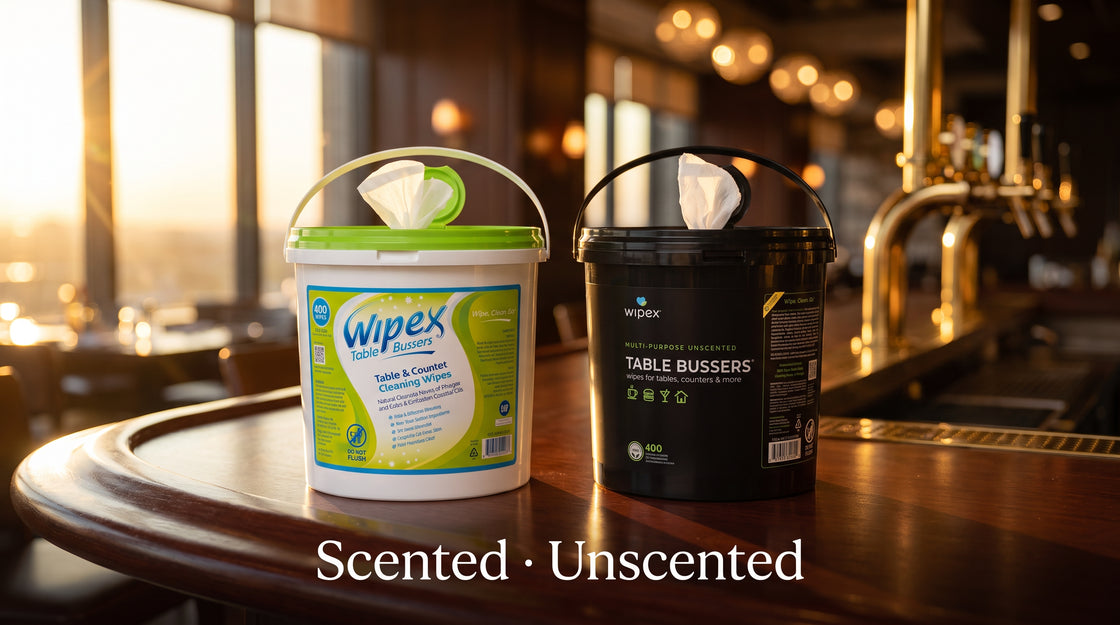
That is why cost per wipe is the wrong unit to manage. Cost per wipe tells you what you spent. Cost per table tells you what the seat cost you — and that is the number your P&L is actually denominated in.
Table Bussers® pre-mixed table wipes make that arithmetic simple: there is one consumable to count, and it is already at the table when the guest stands. By the end of this guide you will be able to calculate your own cost per table, see where the minutes disappear during a reset, and reduce both without lowering the standard a guest notices.
Quick answer / key takeaways
- A pre-mixed table wipe works out at roughly $0.09, so a two-wipe reset costs about $0.15–$0.18 per table in consumables.
- The reset target most operators work to is under 90 seconds (Lavu, checked 23 Sep 2026).
- Casual dining averages about 1.5 turns per hour (Worldmetrics, 2026).
- Labour is 30–35% of expenses in casual dining — the biggest single lever on what a reset really costs (Worldmetrics, 2026).
- Cost per table is not cost per wipe. One is the unit you buy in; the other is the unit you are paid in.
On this page
What cost per table means
Cost per table is the total cost of returning one table to service — the consumable, the labour minutes, and the share of supplies a single reset consumes — divided by how many times the table turns.
It is deliberately not the same as cost per wipe. Cost per wipe is a purchasing figure: it tells you which format is cheaper to buy. Cost per table is an operating figure: it tells you which setup is cheaper to run, including the seconds your staff spend on it. Operators who manage only the first number routinely pay more for the second.
Here is the difference in one line. A cheaper wipe that takes two trips per table is more expensive than a slightly dearer one that takes a single pass.
The three numbers you are really adding up
| Component | What goes in | Where it comes from |
|---|---|---|
| Consumable | the wipe, at your case rate | your supplier invoice |
| Reset labour | minutes per reset × loaded hourly rate | your schedule and payroll |
| Reset count | turns per service × services per week | your POS and your floor |
The first is the only one most purchasing decisions look at. It is also the smallest.
Why Q4 is the moment to measure it
Year-end is when you set next year's par levels and when your supply spend gets reviewed. It is also when front-of-house volume climbs: parties, holiday bookings, private events.
Higher volume does not create a cleaning problem — it multiplies whatever reset routine you already have. If a reset takes three minutes, a busier dining room turns that into three minutes of lost seat time more often, not less often.
That is the argument for measuring cost per table now: the number you calculate in a quiet week is the number you will be running at your busiest, only more times over.
The four-step reset
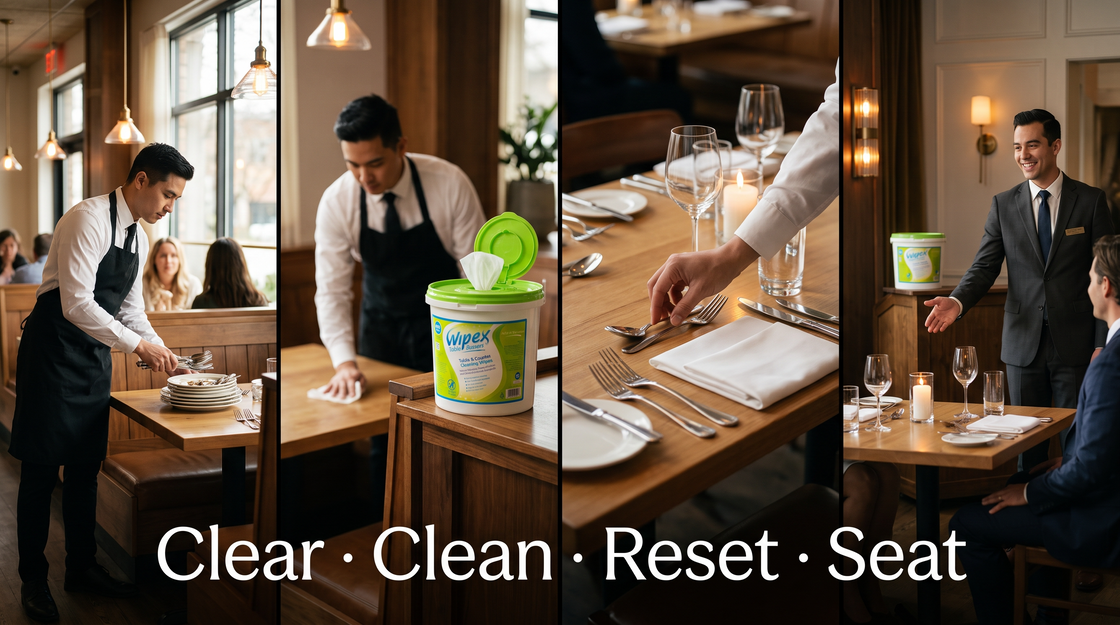
Every reset, in every operation, is the same four moves:
- Clear — plates, glassware and linen leave the table.
- Clean — the surface is wiped, in one pass, before anything is set back down.
- Reset — cutlery, glassware, condiments and settings return.
- Seat — the host is told the table is ready.
We covered this workflow in detail in how table bussers improve restaurant efficiency and table turnover — read that for the staffing and training side. This article stays on the money: what each step costs, and how to bring the cleaning step down without slowing the room.
The cleaning step is the one operators under-measure, because it looks like a small action repeated many times. It is also the step where supplies and minutes meet.
How to calculate your own cost per table
Four inputs, one multiplication.
Step 1 — Your cost per wipe. Take the case price and divide by the wipe count. At the 400-count Table Bussers® bucket price that is roughly $0.09 per wipe; buy the four-pack case and it is about $0.075 per wipe.
Step 2 — Wipes per reset. One wipe per table in a single pass is the target. Allow two if your team commonly returns for a second wipe, and count that second trip in Step 4 as well.
Step 3 — Consumable cost per table. wipes per reset × cost per wipe. At one wipe, about $0.09. At two, about $0.18.
Step 4 — Add the labour minute. Multiply minutes per reset by your loaded hourly rate and divide by 60. At a $16 loaded rate, 45 seconds of reset labour is about $0.12.
cost per table = (wipes per reset × cost per wipe) + (reset minutes ÷ 60 × loaded hourly rate)Run it with real numbers and the picture changes. Labour is 30–35% of expenses in casual dining (Worldmetrics, 2026), so it is the term that dominates the equation — and the term a one-pass wipe actually moves.
Calculate your cost per table
Cost figures only, based on the prices you enter. Check your own invoice.
Worked example: a 20-table room
A 20-table dining room, three turns per table per evening, six services a week:
| Line | Assumption | Weekly |
|---|---|---|
| Resets | 20 tables × 3 turns × 6 services | 360 resets |
| Consumable | 360 × $0.09 | $32.40 |
| Reset labour | 360 × 45 sec = 4.5 hours × $16 | $72.00 |
| Total | $104.40 | |
| Per table | $104.40 ÷ 360 | $0.29 |
Consumables are under a third of the real cost. The rest is the minute.
What a pre-mixed wipe actually changes
It removes the fetch, not the standard: the wipe is already where the cleaning happens, so the cleaning step starts at the table.
What your current setup actually costs
If you are running paper towels and a spray, the consumable looks cheap per sheet — around 5¢ a sheet (The Zero Store, 2026). The reset, though, usually involves a spray bottle and a second trip. It also leaves a wet surface that has to dry before you can set the table.
Laundry is the other invisible line. Operators spend upwards of $200,000 a year getting linen clean (Berkwiper, distributor guide) — and a large part of that volume is table linen that a pre-mixed wipe routine replaces entirely.
None of this argues that one approach is cheaper than another. It argues for measuring both on the same basis: per table, per reset, including the minute.
What a one-pass cleaning step changes
A dedicated busser can cut reset time by roughly half (Restaurant Booking System, Academy). The cleaning step sits inside that time. If the wipe is already at the table, mixed and ready, the busser never leaves the station to fetch a spray or a cloth.
That is the whole proposition of a pre-mixed table wipe: it removes a trip, not a standard.
One consumable, already at the table
One bucket is the whole purchase: no spray, no cloth, and no walk to the station during a reset.
- Removes the fetch from the cleaning step
- One wipe per table in a single pass
- Keeps the standard a guest notices
The five places minutes hide in a reset
Measure one reset with a stopwatch and you will usually find the time is not in the wiping. It is in these five places:
- The fetch. The busser leaves the table to find the spray, the cloth or the wipe. This is usually the single largest cost, and it exists only because the supplies are not at the station.
- The second pass. The first wipe left residue or streaks, so it is done again. One pass is the target; two is a routine that needs changing.
- The wet wait. A wet surface cannot be set. Tableware placed on a damp top gets re-cleared when the guest sits.
- The handoff. The table is ready but nobody has told the host, so it sits empty in a queue.
- The Monday-morning redo. Areas missed at peak get cleaned again at close, at overtime rates.
Only one of those five is the actual cleaning. The other four are layout, stationing and communication problems wearing a cleaning costume.
Fix the first one — put the bucket at the station — and you fix the second and third most of the time, because the busser is no longer walking and no longer rushing.
Bar, patio and private room: three rooms, three costs
Cost per table is not one number for a whole venue. Three rooms usually carry three different resets, and they should be measured separately.
Dining room
The dining room is the baseline: seated covers, a full reset, the highest labour share per table.
Bar
The bar resets more often and more shallowly. Bar tops are deep-cleaned less frequently, so the consumable count per reset is lower, but the reset count per hour is higher — which pushes the labour term up even when the consumable term falls.
Patio and private room
Patios and private rooms are seasonal. A patio that opens for six months a year has its own par level and its own scent decision, because the room may be partly open to the street.
Two formats help here rather than a single SKU across the venue: Table Bussers® Autumn-Scented for the guest-facing rooms and Unscented where guests should not notice anything at all. The certification and food-service documentation belongs to the Autumn SKU only — see the comparison below.
Setting a par level from your reset count
Most operators set a par level from instinct, then discover it in the middle of a Friday. The arithmetic is five minutes of work.
- Count resets per service on a normal week: tables × turns.
- Multiply by wipes per reset.
- Multiply by services per week, then multiply by the weeks between deliveries.
- Add a buffer worth your busiest two weeks of the year — for most venues, that is December.
Run it: 20 tables × 3 turns × 6 services = 360 resets a week. At one wipe per reset that is 360 wipes a week, or just under one 400-count bucket. Two buckets covers a week with the buffer already in it.
The point of a par level is not to hold more stock. It is to make the fetch unnecessary, because there is always a bucket within reach of the station.
Which Table Bussers fits your room
Two formats, one formulation difference that matters for food service.
| Item | Table Bussers® Autumn-Scented | Table Bussers® Unscented |
|---|---|---|
| Suited to | seasonal dining rooms and bars | fragrance-neutral rooms, kitchens, prep areas |
| Scent | cinnamon and clove oils | fragrance-free |
| Format | 400-count bucket, plant-based viscose cloth | 400-count bucket, plant-based viscose cloth |
| NSF | NSF-certified, as the certificate states | not certified |
| Food service | suitable for food service environments | no such claim |
| Cloth | EWG Verified® | EWG Verified® |
Cloth certification in the table above applies to the cloth substrate only, not the finished wipe, formula or packaging.
Read those last two rows carefully. The NSF certification and the food-service environment wording belong to the Autumn-Scented SKU. They do not transfer to the Unscented one, even though the buckets look the same. If a specification or an inspection file needs that paper trail, Autumn is the SKU that carries it.
Autumn-Scented: for guest-facing rooms in the season
Table Bussers® Autumn-Scented is built on a proprietary formulation designed for tables, counters and food-service surfaces, with cinnamon and clove essential oils and cleaning vinegar. It is NSF-certified as the certificate states, and it is the SKU we describe as suitable for food service environments.
Counter tops, tabletops, bar tops and laminate front-of-house surfaces. If in doubt, test on a small, inconspicuous area first.
Unscented: for rooms where nothing should smell
Table Bussers® Natural Unscented Cleaning Wipes use the same plant-based viscose cloth with no fragrance at all — for kitchens, prep areas, and dining rooms where guests notice scent. It is made with natural ingredients, and the cloth is TÜV certified. This applies to the cloth substrate only, not the finished wipe, formula or packaging.
Counters, prep surfaces, tabletops and laminate finishes. If in doubt, test on a small, inconspicuous area first.
The price ladder, per table
| Format | Price | Count | $/wipe | $/table at two wipes |
|---|---|---|---|---|
| Autumn, single bucket | $36.99 | 400 | ≈ $0.09 | ≈ $0.18 |
| Autumn, 2-pack | $69.99 | 800 | ≈ $0.09 | ≈ $0.17 |
| Autumn, 4-pack case | $119.99 | 1,600 | ≈ $0.075 | ≈ $0.15 |
| Unscented, single bucket | $36.99 | 400 | ≈ $0.09 | ≈ $0.18 |
Browse the full food service and commercial collection for case rates across formats. At the case rate, a two-wipe reset is about $0.15. Against the $0.29 all-in cost per table in the worked example, the consumable is still the smaller half of the number.
Which format fits the room

Table Bussers® Autumn-Scented Surface Wipes
Suited to: Guest-facing dining rooms and bar tops
- Pre-mixed — no spray bottle to fetch
- One wipe per table in a single pass
- NSF-certified formulation, suitable for food service environments
 Fragrance-free
Table Bussers® Unscented Surface Wipes
Suited to: Kitchens, prep areas and quiet rooms
- The same pre-mixed format
- Nothing for a guest to notice
- Keeps the cleaning step at the station
Self-assessment: your cost per table and reset time
Run this on one section of your floor. It takes one service to fill in.
Reset time
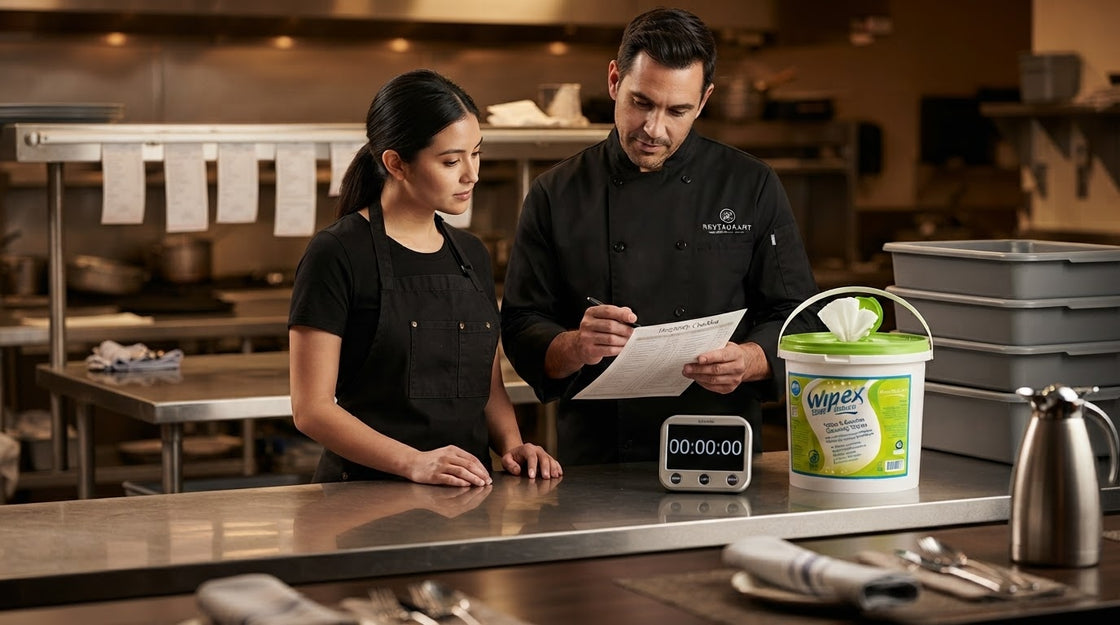
- Time three resets with a phone stopwatch. Start when the guest stands, stop when the table is set.
- Average them.
- If the average is above 90 seconds, watch one reset and count the trips your busser makes. Trips, not effort, are usually the delay.
Cost per table
- Case price ÷ wipe count = cost per wipe.
- × wipes per reset = consumable per table.
- × minutes ÷ 60 × loaded hourly rate = labour per table.
- Add the two.
Then compare against the room
- Weekly resets = tables × turns × services.
- Weekly cleaning cost = weekly resets × cost per table.
- Cost per cover = weekly cleaning cost ÷ covers served.
If cost per cover is a number you have never seen written down, you are not alone — most operators can quote their food cost to one decimal place and have never calculated this one.
Which setup fits your room
Your Q4 front-of-house readiness checklist
Print it, then fill it in before the holiday volume lands.
Progress saves in this browser.
Four things to check before you switch
Certification
Does the product carry the certification your inspections ask for?
Formulation
Is it described for the surfaces you actually have?
Format
Does it put the wipe at the station rather than in a storeroom?
Case rate
Does it improve your cost per table, not just your cost per wipe?
Then measure one section for a week before you change the whole floor.
Frequently asked questions
What is cost per table, and how is it different from cost per wipe?
Cost per wipe is what you paid for a wipe. Cost per table is what it costs to return one table to service — the wipe, plus the labour minute, plus the supplies a single reset consumes. The first is a purchasing number; the second is the operating number your seat revenue is measured against. When the two disagree, the operating number is the one that shows up in your margin.
How do I calculate my own cost per table?
Divide your case price by the wipe count to get your cost per wipe. Multiply by the wipes one reset takes. Then add the labour: minutes per reset, divided by 60, multiplied by your loaded hourly rate. Add the two figures. With a 400-count bucket at $36.99 and a 45-second reset at a $16 loaded rate, that is roughly nine cents of consumable plus about twelve cents of labour — twenty-one cents per table, before any second trip is counted.
What is a good table reset time?
The target most operators work to is under 90 seconds, and a full reset in three to five minutes is typical for casual dining (Lavu, checked 23 Sep 2026; FlipMenu, same date). The most useful thing you can do is measure your own three resets and compare them with the trip count, because extra trips are usually the delay rather than slow hands.
How many wipes does one reset take?
One wipe per table in a single pass is the target, which is why a bucket at the station matters more than a larger count in a storeroom. If your team routinely takes two, budget two — and count the extra trip in the labour line as well, because that second walk is where the cost actually sits.
How does cost per cover relate to cost per table?
Cost per table is what a reset costs. Cost per cover is that cost spread across the guests a table serves. Casual dining averages around 1.5 turns per hour (Worldmetrics, 2026), so a table serving two covers per turn carries half the cleaning cost per cover that a single-cover table does. It is the number that connects cleaning spend to revenue per seat — and the one an owner or a bank will ask for.
Should I use scented or unscented across the dining room and the bar?
Use them by room rather than by preference. Autumn-Scented carries cinnamon and clove oils and is the SKU that is NSF-certified and suitable for food service environments; Unscented is fragrance-free for kitchens, prep areas and rooms where guests should not notice anything at all. The documentation belongs to Autumn only — it does not follow the product family.
What should I check before switching table-cleaning supplies?
Check four things. Does the product carry the certification your inspections ask for? Is the formulation described for the surfaces you actually have? Does the format put the wipe at the station rather than in a storeroom? And does the case rate improve your cost per table, not just your cost per wipe? Then measure one section for a week before you change the whole floor.
Should labour minutes count in my cleaning cost?
Yes — it is usually the larger half. Labour is 30–35% of expenses in casual dining (Worldmetrics, 2026), and reset labour is the share of it that is easiest to reduce without touching service. A one-pass clean step removes a trip; a trip is seconds; seconds are money at three turns per hour.
Keep reading
- How table bussers improve restaurant efficiency and table turnover — the staffing and workflow side of the same problem
- Gym wipe dispensers vs buckets — the same arithmetic applied to a different room
- Buying wipes in bulk — wholesale pricing, MOQs and how to set up a facility account
- Commercial gym cleaning supplies — how to build a repeatable supply system
Reduce Table Turnover Time
Set your cost per table first, then decide what to change. Most operators find the consumable is the smaller half and the extra trip is the larger one.
Shop Table Bussers® Autumn-Scented →Shop Table Bussers® Unscented →Browse the food service collection →
Wipex — Facility Supply Team · Industrial & commercial cleaning specialists · Reviewed 28 September 2026