





 Bulk core
700ct Bulk Gym Refill Roll
Best for: high-volume floors
Large 8"×8" wipes in a high-count roll that fits most dispensers. The lowest-cost-per-wipe core of a recurring program.
Shop bulk refill roll →


...
A sourcing guide for procurement, operations, and facility managers. Learn how to evaluate suppliers, choose bulk formats, standardize across locations, and set up recurring replenishment that never leaves a station empty.
Gym cleaning procurement is the process a fitness facility uses to source, standardize, purchase, and reorder its cleaning supplies as a recurring operational category — not a one-time retail purchase. For wipes specifically, it covers supplier selection, format decisions, bulk ordering, dispenser deployment, inventory, and replenishment cadence.
The distinction matters because a commercial gym doesn't buy cleaning wipes the way a household does. Wipes are a consumable that a facility burns through every operating day, at every cleaning point, for as long as the doors are open. Treated as a retail item, that becomes a stream of small, reactive purchases. Treated as procurement, it becomes a planned supply program with a chosen supplier, a standardized product, and a predictable reorder rhythm.
Everything downstream — cost per wipe, staff time spent restocking, whether stations ever run dry, how easily you can open a second location — flows from how deliberately you set that program up. For the fitness-specific product range referenced throughout, see the Wipex commercial fitness collection.

A sound procurement program moves in a repeatable sequence: define the need, specify the product, select a supplier, choose the format, place a bulk order, and establish replenishment. Done once well, it repeats at every station and every location.
What procurement teams should evaluate. At the specification stage, confirm the product actually fits the surfaces in your facility: equipment upholstery, vinyl, rubber grips, cardio consoles, and studio mats. At the supplier stage, confirm one vendor can support the whole chain — the wipe, a bulk format, a compatible dispenser, and consistent restock — so you're not stitching a system together from multiple sources.
Recommended approach. Standardize on the fewest SKUs that still cover every station type. Fewer SKUs means simpler ordering, easier staff training, and cleaner inventory — the operational payoff of treating this as procurement rather than ad-hoc buying.
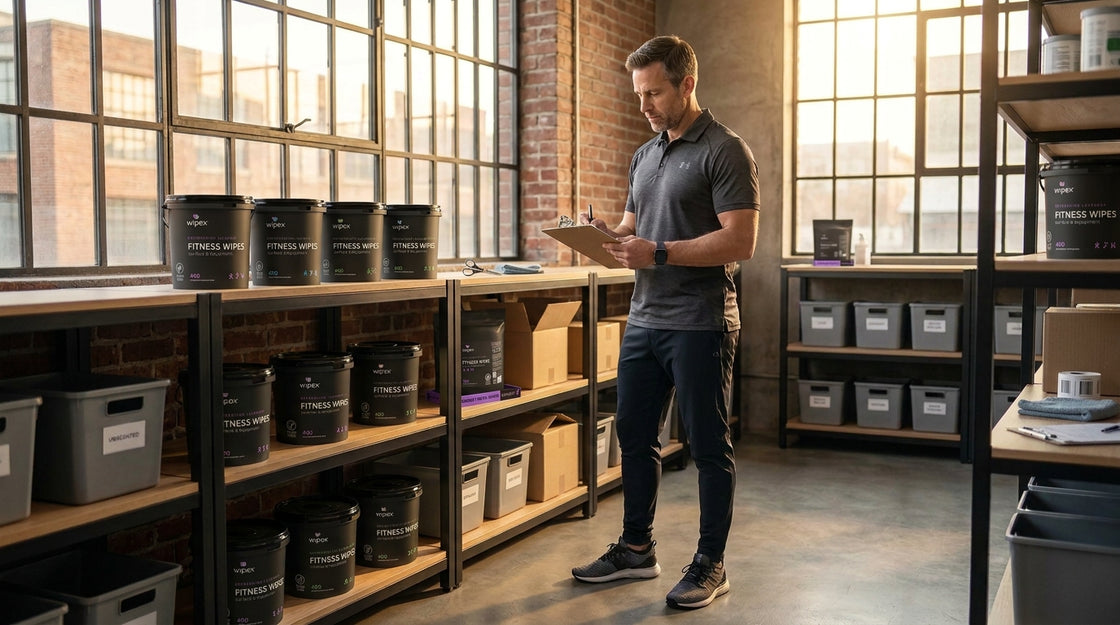
Match format to how each station is used and how much volume it sees. Canisters and buckets suit lower-volume or portable points; bulk refill rolls suit high-volume floors; dispensers paired with refills suit fixed, member-facing stations.
Self-contained formats are the flexible unit of a supply program. A 400ct dispensing bucket is easy to place at a front desk, a secondary studio, or a functional-training zone, and it doubles as portable backup during peak hours. These carry a higher cost per wipe than bulk, so they're best used to complement a bulk core rather than power a busy floor on their own.
For high-volume use, a bulk refill roll is the most efficient procurement unit. Instead of handling many small containers, staff feed a large roll into a dispenser and reload far less often. The Wipex 700ct bulk gym refill roll uses large 8"×8" wipes and fits most wall- and floor-mounted dispensers, which keeps cost per wipe low and reorder cadence predictable.
Dispensers turn a bulk roll into a standardized cleaning station. Wall-mounted units preserve floor space in corridors and cardio rows; a free-standing floor dispenser creates a visible, member-facing point in open zones and studios. Standardizing on one or two dispenser types across the facility keeps refills interchangeable and restocking uniform.
No single model is universally best. The right mix depends on station volume, how much handling your team can absorb, and how many points you're supplying.
| Procurement model | Operational effect | Best for |
|---|---|---|
| Small individual containers | More frequent replenishment, higher cost per wipe | Lower-volume / secondary stations |
| Dispensing bucket (400ct) | Flexible, portable supply | Front desk, studios, backup stock |
| Bulk refill roll (700ct) | Fewer refill events, lower cost per wipe | High-volume commercial floors |
| Dispenser + refill | Standardized, member-facing station | Fixed commercial cleaning points |
| Standardized SKU program | Consistent ordering across sites | Multi-location & franchise operators |
Instead of chasing a headline discount, evaluate total cost of ownership: cost per wipe, replenishment labor, storage, and station availability. The cheapest unit price isn't always the lowest real cost.
Two simple calculations let you compare options on your own numbers rather than borrowed ones:
Cost per wipe = total product cost ÷ usable wipes
Monthly wipe demand ≈ average daily usage × operating days
These are illustrative formulas, not fixed figures — plug in your observed usage. The value of bulk formats usually shows up in two places the sticker price hides: a lower cost per wipe at volume, and less staff time spent handling and swapping containers. A busy station that a team reloads once from a 700ct roll costs far less in labor than one refilled repeatedly from small containers. Factor storage too: bulk formats consume less shelf space per wipe than an equivalent count of individual canisters.
A mid-size commercial gym should build its program around bulk refill fed into fixed dispensers, with buckets and canisters as flexible backup — then set a reorder trigger so supply is never reactive.

The point of an example isn't a fixed shopping list; every facility differs. It's a workflow you can run on your own floor — count your stations, estimate demand from your own usage, choose a bulk core, and lock in a reorder cadence before supply becomes reactive.
Run the following workflow on your own floor:
For operators running two, five, or a full franchise network, the biggest procurement win is standardization: the same wipe, format, dispenser, and reorder process at every site.
When each location sources its own supplies, you get drift — different products, inconsistent stations, uneven member experience, and purchasing that's impossible to forecast. Standardizing a single system across sites simplifies almost everything downstream: staff training becomes one process instead of many, inventory is comparable location to location, reordering follows one cadence, and opening a new site is a rollout of a known setup rather than a fresh sourcing project each time.
Practically, that means agreeing on a small set of SKUs — a primary wipe, a bulk refill, and a standard dispenser — and repeating them everywhere. Wipex supports this with a consistent fitness wipe, bulk refill, bucket, and dispenser range that can be deployed the same way across gyms, Pilates studios, yoga studios, and wellness facilities.
Use this to evaluate any supplier and structure your own program. A strong fitness cleaning supplier should support every line below.
Pick the description that fits your operation to see a recommended starting point.
For a single location with moderate volume, standardize on one primary wipe format and a dispensing bucket, keeping ordering simple while you learn your true usage.
Shop the 400ct dispensing bucket →Each of these is a building block of a recurring fitness cleaning supply program — chosen by facility application, volume, and station type.
Bulk core
Best for: high-volume floors
Large 8"×8" wipes in a high-count roll that fits most dispensers. The lowest-cost-per-wipe core of a recurring program.
Shop bulk refill roll → Station layer
Best for: fixed, standardized stations
Wall and floor dispensers that turn a bulk roll into a consistent, member-facing cleaning point across every location.
Explore dispensers → Flexible backup
Best for: secondary & portable points
A portable dispensing bucket for front desks, studios, and peak-day backup — the flexible unit alongside your bulk core.
Shop dispensing bucket →Gym cleaning procurement is the process a fitness facility uses to source, standardize, purchase, and reorder cleaning supplies as an ongoing operating category rather than as occasional retail purchases. For wipes, it typically includes supplier selection, format decisions, dispenser setup, inventory planning, and reorder timing.
Most gyms buy cleaning supplies in bulk by standardizing one primary wipe format, estimating demand from actual station usage, and setting a recurring reorder cadence. High-volume facilities often use refill rolls as the core format because they reduce handling and support fixed dispensers, while buckets or canisters can serve as backup for smaller or portable stations.
A gym should look for a supplier that offers equipment-safe wipes, reliable refill availability, dispenser compatibility, and consistent reordering support. It also helps if the supplier can support the same system across different station types or multiple locations, which makes training, purchasing, and inventory control easier to standardize.
For many high-volume commercial gyms, bulk refill rolls are more efficient than small canisters because they hold more wipes, reduce refill frequency, and make it easier to standardize stations across the floor. Smaller containers can still work well in lower-volume or portable settings, so the right format depends on traffic, layout, and staffing.
Commercial gyms should reorder cleaning wipes based on an inventory trigger rather than waiting to run out. A practical approach is to estimate monthly demand from average daily usage and operating days, then set a minimum on-hand stock level for each primary format. That makes reordering more predictable and reduces the chance of empty stations during busy periods.
Fitness franchises usually standardize cleaning supplies by selecting a small set of approved SKUs, such as one primary wipe, one refill format, and one or two dispenser types, then deploying them the same way across locations. This simplifies staff training, inventory management, reordering, and new-site setup.
A 500-member gym typically needs a cleaning setup built around member-facing wipe stations, backup stock, and a reorder plan based on real usage. Many facilities of that size use fixed dispensers with refill rolls at primary stations, then keep buckets or canisters available for studios, overflow demand, or secondary areas.
Commercial gyms can source cleaning wipes in bulk from commercial janitorial suppliers, facility supply vendors, or fitness-focused cleaning suppliers that offer wipes, refill formats, and compatible dispensers together. When comparing vendors, look at product compatibility, refill availability, dispenser support, and how well the supplier can support recurring commercial orders.
From a single facility to a multi-location network, Wipex helps you standardize fitness wipes, bulk refills, and dispensers with recurring, predictable replenishment.